


The Hindu Editorial Analysis
21 April 2026
State Legislative Assembly and its Elections
(Source – The Hindu, International Edition, Page no.-8 )
Topic : GS2 – Polity; parliamentary structure
Why in news: Recent debates highlight concerns over free and fair State Assembly elections, misuse of power, electoral reforms, and the need to strengthen democratic accountability in states.
Key Details
- State Legislative Assembly is the directly elected lower house representing people at the state level and forms the core of state democracy.
- Elections are conducted by the Election Commission of India, ensuring free, fair, and periodic polls.
- Members are elected through the First-Past-The-Post system, where the candidate with the highest votes wins.
- The Assembly exercises legislative, financial, and executive control, making it the most powerful state institution.
- Political parties play a central role in candidate selection, campaigning, and government formation.
- Issues like money power, criminalization, and electoral transparency remain key challenges in elections.
State Legislative Assembly: Meaning and Structure
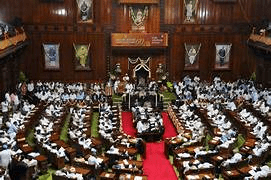
- The State Legislative Assembly (Vidhan Sabha) is the lower house of the state legislature in India and represents the direct will of the people through elected representatives.
- Composition: It consists of members directly elected by the people from territorial constituencies within the state.
- Size of Assembly: The strength of the Assembly varies between 60 to 500 members, depending on the population of the state, with some smaller states having exceptions.
- Tenure: The normal tenure of the Assembly is 5 years, but it can be dissolved earlier by the Governor or during a constitutional crisis.
- Presiding Officer: The Assembly is headed by a Speaker, who maintains order and conducts proceedings impartially.
Powers and Functions of the Legislative Assembly
- Legislative Powers: The Assembly has the authority to make laws on subjects in the State List and Concurrent List under the Constitution.
- Financial Powers: It holds exclusive control over state finances, including passing the budget and Money Bills.
- Executive Control: The Council of Ministers is collectively responsible to the Assembly, ensuring accountability of the government.
- Electoral Functions: Members participate in the election of the President of India and sometimes in filling vacancies in the Rajya Sabha.
- Amendment Role: It plays a role in constitutional amendments when ratification by states is required.
State Legislative Assembly Elections: Overview
- Nature of Elections: Elections to the Assembly are direct, democratic, and based on universal adult suffrage, meaning every citizen above 18 can vote.
- Conducting Authority: Elections are conducted by the Election Commission of India, ensuring free and fair processes.
- Election Frequency: Elections are generally held every 5 years, unless the Assembly is dissolved earlier.
- Constituencies: Each state is divided into single-member constituencies, where one representative is elected.
- Voting System: India follows the First-Past-The-Post (FPTP) system, where the candidate with the highest votes wins.
Eligibility and Qualifications for Candidates
- Citizenship: A candidate must be a citizen of India to contest elections.
- Age Requirement: The minimum age to contest Assembly elections is 25 years.
- Voter Registration: The candidate must be a registered voter in any constituency in India.
- Other Conditions: The candidate must not hold an office of profit and should not be disqualified under any law.
- Clean Legal Status: Individuals convicted of certain offenses or engaging in corrupt practices may be disqualified from contesting.
Election Process
- Notification of Elections: The Election Commission issues an official notification announcing election dates and procedures.
- Filing Nominations: Candidates submit nomination papers, which are scrutinized for validity.
- Campaigning: Candidates conduct election campaigns, adhering to the Model Code of Conduct.
- Voting: Voting is conducted using Electronic Voting Machines (EVMs) in a secret ballot system.
- Counting and Results: Votes are counted, and the candidate with the maximum votes is declared elected.
Role of Political Parties
- Candidate Selection: Political parties nominate candidates based on strategy and public support.
- Manifestos: Parties release manifestos outlining policies and promises to attract voters.
- Campaign Management: Parties organize rallies, advertisements, and outreach programs.
- Government Formation: The party or coalition with a majority of seats forms the government in the state.
Importance of State Legislative Assembly Elections
- Democratic Representation: Elections ensure that people’s voices are reflected in governance at the state level.
- Policy Making: Elected representatives shape laws and policies affecting daily life, such as health, education, and law & order.
- Accountability: Regular elections make the government answerable to the जनता (people).
- Federal Structure: These elections strengthen India’s federal system by empowering states.
- Political Participation: They encourage citizen involvement in democracy and political awareness.
Special Features and Provisions
- Reservation of Seats: Seats are reserved for Scheduled Castes (SCs) and Scheduled Tribes (STs) to ensure inclusive representation.
- Anti-Defection Law: Members cannot switch parties arbitrarily, ensuring political stability.
- Governor’s Role: The Governor can summon, prorogue, or dissolve the Assembly.
- Emergency Situations: During a National Emergency, the term of the Assembly may be extended by Parliament.
Conclusion
State Legislative Assembly elections remain the cornerstone of India’s federal democracy, ensuring representation, accountability, and responsive governance. Strengthening electoral integrity, curbing malpractices, and enhancing institutional transparency are essential for deepening democratic values. Continuous reforms and vigilant oversight can ensure that elections truly reflect the will of the people and uphold constitutional principles.
EXPECTED QUESTIONS FOR PRELIMS:
Q. Consider the following statements regarding State Legislative Assembly elections:
- Elections are conducted by the Election Commission of India.
- Members are elected using the proportional representation system.
- The minimum age to contest elections is 25 years.
Which of the statements given above is/are correct?
(a) 1 and 3 only
(b) 2 and 3 only
(c) 1 and 2only
(d) 1, 2 and 3
Answer: a