


The Defence Decade: India’s Enhanced Capability, Capacity & Credibility (2014–2026)
(Source: PIB | Ministry of Defence)
Topic: GS-2: International Relations | Security Diplomacy, GS-3: Defence Technology | Internal Security | Defence Manufacturing
Key Highlights
- Defence Budget: ₹2.53 lakh cr (FY14) → ₹7.85 lakh cr (FY27)
- Indigenous Defence Production: ₹1.78 lakh cr (FY26)
- Defence Exports: ₹38,424 cr to 80+ countries
- Industrial Licences: 258 → 834
- iDEX Contracts: 551
- Private Sector Share: 24% of total production
- Defence Export Target: ₹50,000 cr by 2029
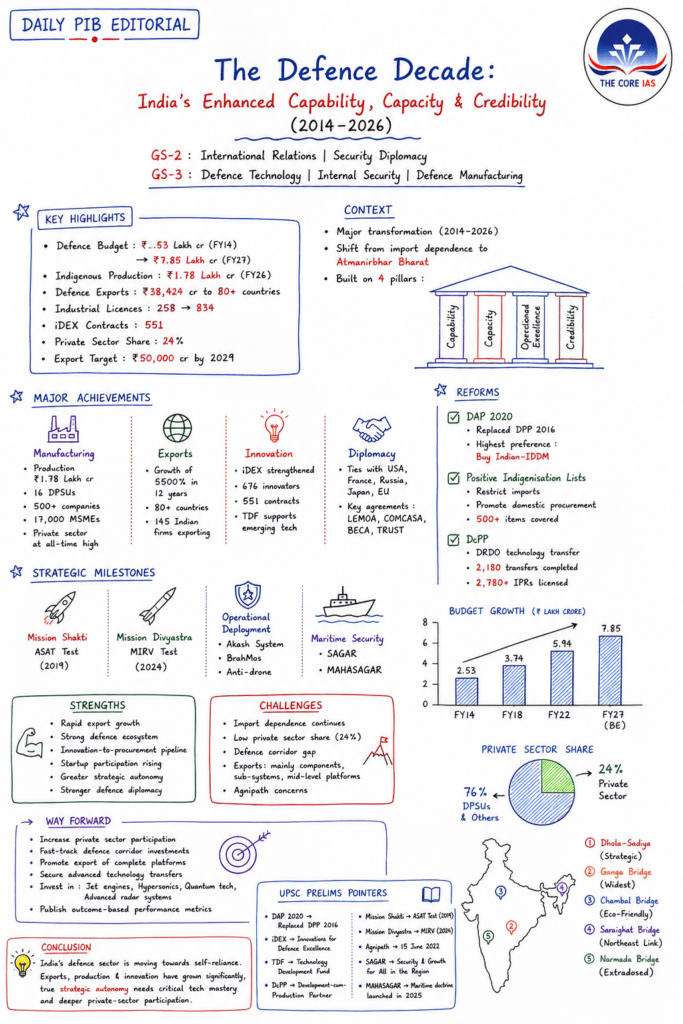
Context
- India’s defence sector has undergone major transformation during 2014–2026.
- Focus shifted from import dependence to Atmanirbhar Bharat.
- Strategy built on four pillars:
* Capability
* Capacity
* Operational Excellence
* Credibility
Major Achievements
Defence Manufacturing Growth
- Indigenous production reached ₹1.78 lakh crore.
- Defence ecosystem includes:
* 16 DPSUs
* 500+ licensed companies
* 17,000 MSMEs
- Private sector participation reached an all-time high.
Defence Exports Boom
- Exports increased by over 5,500% in 12 years.
- Export basket now reaches 80+ countries.
- 145 Indian firms exporting defence products.
Innovation Ecosystem
- iDEX strengthened startup participation.
- 676 innovators engaged.
- 551 design and development contracts signed.
- TDF supports emerging technologies.
Defence Diplomacy
- Strengthened ties with:
* USA
* France
* Russia
* Japan
* EU
- Key agreements:
* LEMOA (2016)
* COMCASA (2018)
* BECA (2020)
* TRUST (2025)
Important Reforms
DAP 2020
- Replaced DPP 2016.
- Highest procurement preference:
* Buy Indian–IDDM
* (Indigenously Designed, Developed & Manufactured)
Positive Indigenisation Lists
- Restrict imports of selected defence items.
- Promote domestic procurement.
- 500+ items covered.
Development-cum-Production Partner (DcPP)
- DRDO technology transfer framework.
- 2,180 technology transfers completed.
- 2,780+ IPRs licensed.
Strategic Milestones
- Mission Shakti (ASAT Test) – 2019
- Mission Divyastra (MIRV Agni-5) – 2024
- Operational deployment of:
* Akash Missile System
* BrahMos Missile
* Anti-drone systems
- Enhanced maritime security through:
* SAGAR
* MAHASAGAR
Strengths
- Rapid export growth.
- Strong defence-industrial ecosystem.
- Improved innovation-to-procurement pipeline.
- Growing startup participation.
- Greater strategic autonomy.
- Stronger defence diplomacy.
Challenges
Import Dependence Continues
- India remains among the world’s largest arms importers.
- Critical technologies still imported:
* Jet engines
* Submarine propulsion
* Advanced sensors
* Space-based ISR systems
Low Private Sector Share
- Private sector contribution only 24%.
- DPSUs continue to dominate production.
Defence Corridor Gap
- Large gap between investment commitments and actual investments.
- Industrial capacity expansion remains uneven.
Export Profile
- Exports mainly:
* Components
* Sub-systems
* Mid-level platforms
- Limited exports of high-end strategic systems.
Agnipath Concerns
- Questions on:
* Long-term retention
* Military experience
* Regimental cohesion
Way Forward
- Increase private sector participation.
- Fast-track defence corridor investments.
- Promote export of complete weapon platforms.
- Secure advanced technology transfers.
- Invest in:
* Jet engines
* Hypersonics
* Quantum technologies
* Advanced radar systems
- Publish outcome-based performance metrics.
UPSC Prelims Pointers
- DAP 2020 → Replaced DPP 2016.
- iDEX → Innovations for Defence Excellence.
- TDF → Technology Development Fund.
- DcPP → Development-cum-Production Partner.
- Mission Shakti → ASAT Test (2019).
- Mission Divyastra → MIRV Test (2024).
- Agnipath → Launched on 15 June 2022.
- SAGAR → Security and Growth for All in the Region.
- MAHASAGAR → Maritime doctrine launched in 2025.
Conclusion
- India’s defence sector has moved from a predominantly import-dependent model toward a more self-reliant ecosystem. While exports, indigenous production and innovation have expanded significantly, achieving true strategic autonomy will require mastery over critical technologies and deeper private-sector participation.