


PRAHAAR: India’s First National Counter-Terrorism Policy & Strategy
(Source: PIB Analysis | Ministry of Home Affairs)
Topic: GS-3: Internal Security | Terrorism | Cyber Security , GS-2: International Cooperation | Legal Reforms
Context
- MHA unveiled PRAHAAR on 23 February 2026.
- India’s first comprehensive National Counter-Terrorism Policy.
- Integrates legal, institutional, operational and diplomatic responses under a unified framework.
- Based on a Zero-Tolerance Approach to Terrorism.
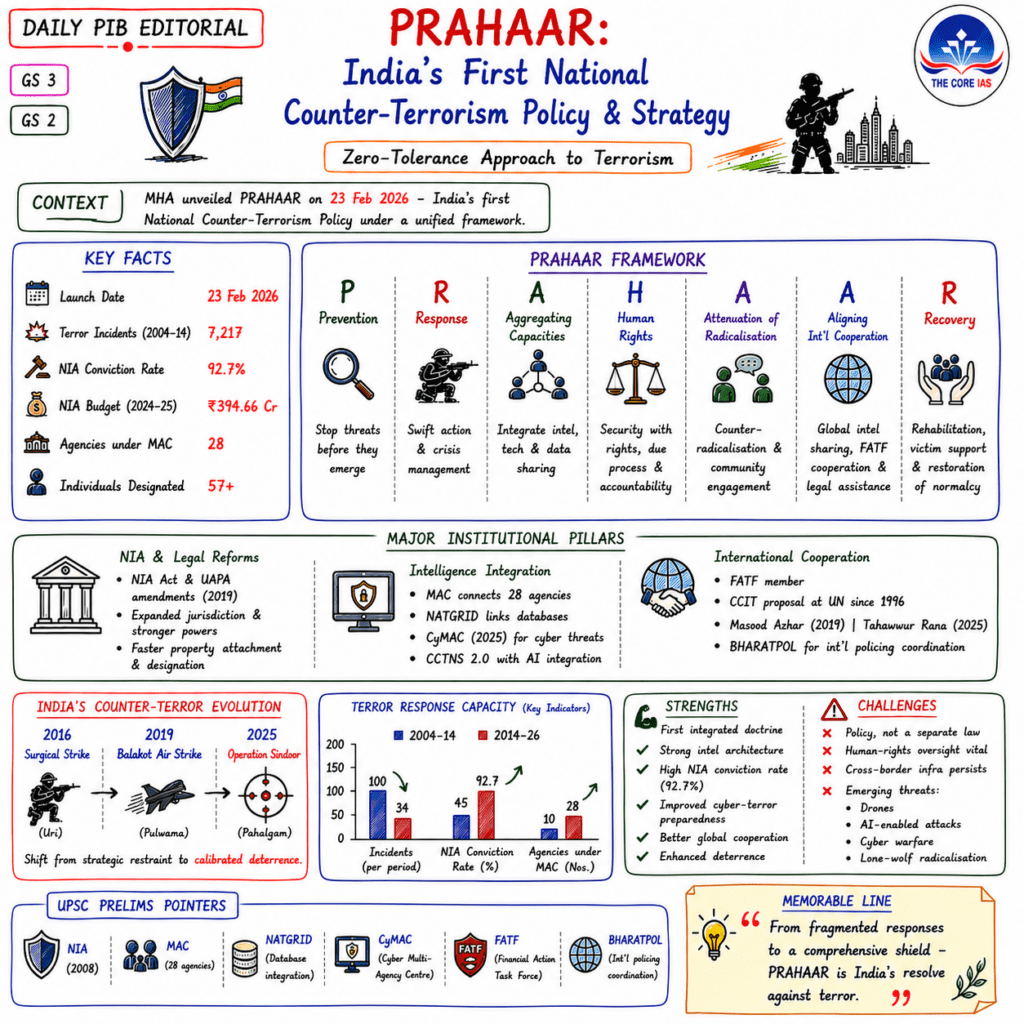
Key Facts
| Indicator | Data |
|---|---|
| Launch Date | 23 Feb 2026 |
| Terror Incidents (2004–14) | 7,217 |
| NIA Conviction Rate | 92.7% |
| NIA Budget (2024-25) | ₹394.66 Cr |
| Agencies under MAC | 28 |
| Individual Terrorists Designated | 57+ |
Why PRAHAAR Was Needed?
- Cross-border terrorism from Pakistan-based groups.
- Online radicalisation and ISIS influence.
- Growing cyber-terror threats.
- Need for better intelligence coordination.
- Lack of a unified national counter-terror doctrine.
PRAHAAR Framework
P – Prevention
- Early intelligence gathering
- Terror financing disruption
- Border security strengthening
R – Response
- Rapid counter-terror operations
- Crisis management mechanisms
- Inter-agency coordination
A – Aggregating Capacities
- Integration of intelligence agencies
- Technology-driven surveillance
- Data sharing platforms
H – Human Rights
- Balance security with civil liberties
- Due-process safeguards
- Legal accountability
A – Attenuation of Radicalisation
- Counter-radicalisation programmes
- Community engagement
- Online extremism monitoring
A – Aligning International Cooperation
- FATF cooperation
- Intelligence sharing
- Extradition and legal assistance
R – Recovery
- Rehabilitation of affected regions
- Victim support systems
- Restoration of normalcy
Major Institutional Pillars
NIA Strengthening
- NIA Amendment Act, 2019
- Jurisdiction expanded to:
- Cyber terrorism
- Human trafficking
- Transnational crimes
UAPA Amendment, 2019
- Individual terrorists can be designated.
- Faster property attachment.
- Enhanced investigative powers.
Intelligence Integration
- MAC connects 28 agencies.
- NATGRID links security databases.
- CyMAC launched in 2025 for cyber threats.
- CCTNS 2.0 enabled through AI integration.
India’s Counter-Terror Evolution
Surgical Strike (2016)
- Response to Uri attack.
Balakot Air Strike (2019)
- Response to Pulwama attack.
Operation Sindoor (2025)
- Post-Pahalgam counter-terror response.
Significance: Shift from strategic restraint to calibrated deterrence.
International Cooperation
- FATF membership.
- No Money for Terror Conferences.
- CCIT proposal at UN since 1996.
- Masood Azhar designated global terrorist (2019).
- Tahawwur Rana extradition (2025).
- BHARATPOL launched for international policing coordination.
Strengths
- First integrated national counter-terror doctrine.
- Strong intelligence coordination architecture.
- High NIA conviction rate.
- Improved cyber-terror preparedness.
- Better global cooperation against terror financing.
- Enhanced deterrence against cross-border terrorism.
Challenges
- PRAHAAR is a policy, not a separate law.
- Human-rights oversight remains important.
- Cross-border terror infrastructure persists.
- Emerging threats:
- Drones
- AI-enabled attacks
- Cyber warfare
- Lone-wolf radicalisation
UPSC Value Addition
Important Institutions
- NIA
- MAC
- NATGRID
- CyMAC
- FATF
- INTERPOL
- BHARATPOL
Important Laws
- UAPA, 1967 (Amended 2019)
- NIA Act, 2008 (Amended 2019)
- Bharatiya Nyaya Sanhita, 2023
- PMLA, 2002
Way Forward
- Independent review mechanisms for anti-terror laws.
- Strengthen CyMAC against AI and drone threats.
- Push global adoption of CCIT.
- Expand intelligence-sharing partnerships.
- Improve community-based de-radicalisation efforts.
Conclusion
- PRAHAAR marks a shift from fragmented responses to a comprehensive counter-terror architecture. Its success will depend on balancing strong security measures with constitutional safeguards while adapting to emerging threats in cyberspace and hybrid warfare.