


The Hindu Editorial Analysis
5 December 2025
New Delhi’s Relative Isolation, India’s Tryst with Terror
(Source – The Hindu, International Edition – Page No. – 8)
Topic : GS Paper II & III – International Relations | Internal Security | Terrorism & Neighbourhood Policy
Context
The editorial expresses concern over India’s growing diplomatic isolation and the reemergence of terror-related challenges amid shifting regional dynamics in South Asia.
India, once a proactive regional stabiliser, now appears “on the sidelines” of major global and regional developments—from West Asia’s crises to the Indo-Pacific power contest—while internal and cross-border terrorism resurfaces as a pressing national-security concern.
1. India’s Strategic Isolation
- India’s diplomatic influence, though respected, seems less assertive in present crises:
- West Asia conflicts (Gaza, Iran crisis),
- European security instability (Ukraine war),
- and Indo-Pacific realignments.
- The author calls this a rare moment when India is a “virtual onlooker” rather than a participant shaping regional outcomes.
- In South Asia too, India faces turbulence — Afghanistan’s instability, Nepal’s political flux, Myanmar’s civil war — leaving India with limited dependable allies.
2. Hostile Periphery: Pakistan and Bangladesh
- On the western front, Pakistan has raised rhetoric over Kashmir and nuclear deterrence.
- The 7th Constitutional Amendment Bill 2024 gives Pakistan’s Army Chief enhanced powers, reducing civilian oversight — a shift Narayanan calls “dangerous for India’s security equation.”
- On the eastern front, Bangladesh is tilting towards Pakistan and China.
- The visit of a Pakistani navy ship to Bangladesh after half a century symbolises renewed strategic linkages and a potential two-front challenge.
Implication: India’s neighbourhood, once influenced by its democratic and economic weight, is undergoing a geostrategic drift away from New Delhi.
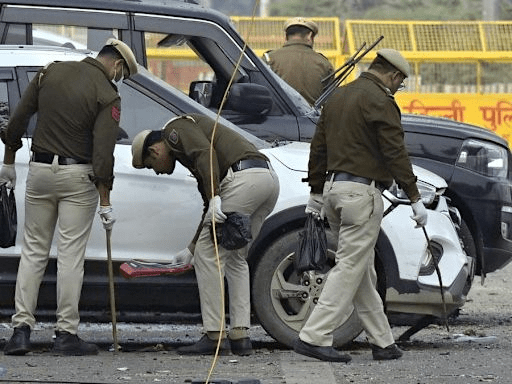
3. Resurgence of ‘Urban Terror’
- The article highlights a worrying revival of urban terrorism after a decade-long lull.
- Recent terror modules uncovered in Faridabad, Delhi, and Jammu & Kashmir involve educated professionals, medical students and technocrats.
- Their links trace back to groups such as Lashkar-e-Taiba and Jaish-e-Mohammed, and to Pakistan’s security establishment.
- The author warns that India’s multi-religious, multi-regional society makes terrorism not only a law-and-order issue but a threat to social cohesion and national unity.
4. Comparative Analysis — Echo of the 1990s
- The current pattern of ideological radicalisation mirrors the early 1990s phase when terror spread from Kashmir to Indian metropolises following the Babri Masjid demolition and subsequent communal violence.
- This time, however, the network is more diffuse, digitally enabled and globally linked — with recruitment and funding traced to Pakistan, UAE, and Turkey.
5. Policy Imperatives: What India Must Do
- Diplomatic Re-Engagement:
- Reassert India’s regional role through active involvement in West Asia and Indo-Pacific fora.
- Reinforce bilateral ties with Bangladesh, Nepal and Sri Lanka to offset Chinese and Pakistani influence.
- Strengthen Counter-Terror Architecture:
- Modernise intelligence coordination between IB, RAW and state agencies.
- Focus on urban counter-radicalisation programmes and monitor digital propaganda pipelines.
- Socio-Political Cohesion:
- Prevent alienation of minorities and regional communities through inclusive governance and communication.
- Strategic Preparedness:
- Stay alert to the possibility of limited conflict with Pakistan and two-front security pressures.
Conclusion
“India cannot afford either isolation or inaction.”
M. K. Narayanan argues that India’s diplomatic reticence and slow response to emerging security risks may embolden hostile powers and terror networks. He calls for a balanced approach — strategic re-engagement abroad and cohesion at home.
India’s credibility as a regional power depends not just on its economic rise but on its capacity to lead through security stability and neighbourhood trust.