


The Hindu Editorial Analysis
11 March 2026
Inside China: authority, conflict and strategic challenges
(Source – The Hindu, International Edition, Page no.-10 )
Topic: GS Paper 2 – International Relations | GS Paper 3 – Security / Global Politics
Introduction
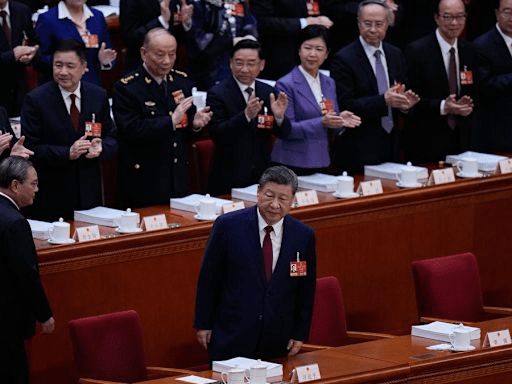
China’s political evolution since 1949 has been shaped by powerful leaders such as Mao Zedong, Deng Xiaoping and Xi Jinping. Each leader consolidated authority in different ways while maintaining the central role of the Chinese Communist Party (CPC). However, despite China’s rise as a major global power, internal political tensions and institutional struggles continue to shape its governance and strategic posture.
I. Evolution of Political Authority in China
Since the establishment of the People’s Republic of China in 1949, power has largely been concentrated in the leadership of the Communist Party.
Three leaders have particularly defined China’s political trajectory:
- Mao Zedong – established revolutionary authority and ideological dominance.
- Deng Xiaoping – initiated economic reforms and market-oriented policies.
- Xi Jinping – consolidated political power and strengthened party control over state institutions.
These leaders shaped China’s internal governance as well as its global strategy.
II. Internal Power Struggles within the CPC
Despite the perception of China as a unified political system, internal tensions exist within the Communist Party.
Recent developments indicate:
- Periodic purges of senior officials.
- Removal of high-ranking military and political leaders.
- Anti-corruption campaigns targeting influential figures.
For example, the removal of senior People’s Liberation Army officials suggests attempts to maintain strict loyalty to the central leadership.
Such actions may reflect:
- Internal factional rivalries.
- Concerns about dissent within the party.
- Efforts to reinforce political control.
III. Institutional Challenges within China
China’s political system also faces institutional challenges that may affect governance.
These include:
- Trust deficit within leadership structures.
- Economic concerns, including slowing growth and structural challenges.
- Institutional inefficiencies within governance systems.
These pressures may contribute to rising tensions within the political hierarchy.
IV. Impact on China’s Global Credibility
Internal instability may also influence China’s global reputation.
Recent developments have highlighted:
- China’s difficulty in asserting influence in certain geopolitical crises.
- Challenges in shaping outcomes in regions such as West Asia and Latin America.
- Perceptions of limited ability to counterbalance U.S. power in certain contexts.
These developments could weaken China’s image as an emerging global superpower.
V. China’s Strategic Behaviour in Global Politics
Despite internal tensions, China has shown increasing caution in its external behaviour.
Examples include:
- Avoiding direct confrontation with the United States in several international disputes.
- Adopting a restrained approach in global conflicts.
- Emphasising economic and technological advancement.
China continues to lead in sectors such as:
- Electric vehicles
- Artificial intelligence
- pharmaceuticals
- logistics technologies
This technological leadership strengthens China’s long-term global influence.
VI. Implications for India
China’s internal dynamics are strategically significant for India.
1. Strategic Competition
China remains India’s primary geopolitical competitor in Asia.
2. Border and Security Concerns
Internal pressures within China could influence its behaviour along the India–China border.
3. Regional Power Balance
Changes in China’s internal political structure may affect power dynamics in Asia.
4. Diplomatic Opportunities
Understanding China’s domestic challenges may provide India with strategic opportunities in diplomacy and regional partnerships.
Conclusion
China’s rise as a global power has been accompanied by strong centralised leadership and political control. However, internal tensions within the Chinese Communist Party, combined with economic and institutional challenges, may shape China’s future trajectory. For India and the wider international community, a deeper understanding of China’s internal political dynamics is essential for navigating the evolving geopolitical landscape.