


The Hindu Editorial Analysis
30 March 2026
A missed opportunity to guarantee minimum wages
(Source – The Hindu, International Edition, Page no.-10 )
Topic : GS Paper: GS-2 (Government Policies, Welfare Schemes, Social Justice) and GS-3 (Employment, Inclusive Growth)
Context
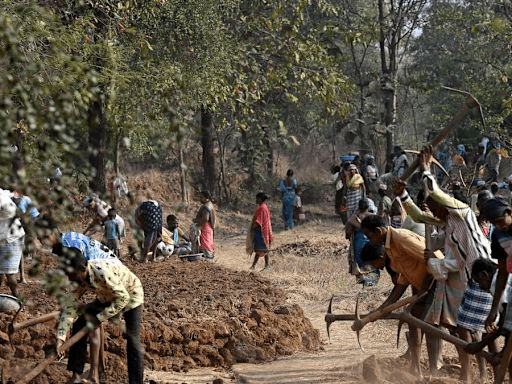
The editorial discusses the ongoing debate around wage provisions under MGNREGA and the newly enacted VB-GRAM Act. It highlights a critical gap in policy design—the failure to ensure statutory minimum wages for rural workers, raising concerns about wage suppression, legality, and the effectiveness of employment guarantee programmes.
Core Issue
The central issue is the weakening of wage protection under employment guarantee schemes, due to:
- Central control over wage fixation instead of alignment with minimum wages
- Real wage stagnation under MGNREGA
- Absence of strong legal guarantees in the VB-GRAM Act
This raises a key question:
Can employment guarantee schemes remain effective if they fail to ensure minimum wages?
Wage Rate as a Critical Parameter
- Wage rates determine the attractiveness and success of employment programmes
- Higher wages encourage worker participation
- Suppressed wages can weaken or phase out programmes over time
Legal framework:
- Section 6(1): Central government notifies MGNREGA wages
- Section 6(2): If not notified, State minimum wages apply
Initially, State-level minimum wages often exceeded MGNREGA wages, making the scheme less attractive in some regions.
Shift in Wage Policy and Its Implications
- In 2009, the central government began notifying wages nationally
- This initially increased wages but later led to stagnation
- Over time, real wages were effectively frozen, adjusted only marginally for inflation
Outcome:
Centralisation of wage setting limited wage growth and reduced State flexibility.
Real Wage Freeze and Its Consequences
Two major issues emerged:
- MGNREGA wages fell below minimum wages in many States
- Violates the principle of ensuring minimum livelihood
- Raises legal and constitutional concerns
- Wages lagged behind market wages
- Reduced attractiveness of the scheme
- Lower participation over time
Additional concerns:
- Delayed wage payments
- Payment failures due to digital systems (Aadhaar-based payments, NMMS)
- Growing “discouragement effect” among workers
Impact on Rural Labour Market
- Initially, MGNREGA strengthened rural wages (2009–2014)
- Later, stagnation reduced its influence
Result:
- Decline in bargaining power of rural workers
- Increased vulnerability of informal labour
- Weakening of rural safety net
Continuing Policy Failure: VB-GRAM Act
The VB-GRAM Act fails to correct existing anomalies:
- Does not guarantee minimum wages
- Retains centralised wage determination
- Lacks provisions to ensure timely payments or reduce corruption
Key concern:
- Removal of legal safeguards without providing alternatives
- Risk of institutionalising wage suppression
Legal and Constitutional Concerns
- MGNREGA included a non-obstante clause overriding minimum wage law
- VB-GRAM Act lacks such clarity
Implication:
- Paying below minimum wages may become legally indefensible
- Raises questions about violation of labour rights and dignity
Governance and Implementation Issues
- Leakages and corruption linked to weak monitoring
- Worker disengagement reduces accountability
- Digital systems create exclusion errors
Observation:
- Wage suppression and governance failures reinforce each other
Way Forward
- Ensure wages under employment schemes are equal to or higher than minimum wages
- Restore linkage with State-specific wage realities
- Improve wage payment systems and reduce delays
- Strengthen transparency and accountability mechanisms
- Design employment programmes to support real wage growth and rural demand
Conclusion
Employment guarantee schemes derive legitimacy from their ability to provide dignified wages and livelihood security.
By failing to ensure minimum wages, current policy risks undermining both legal principles and social justice objectives.
A credible employment framework must prioritise fair wages, timely payments, and worker protection to remain meaningful in addressing rural distress.