


The Hindu Editorial Analysis
16 December 2025
A broad-based development model
(Source – The Hindu, International Edition – Page No. – 8)
Topic : GS 3: Indian Economy and issues relating to planning, mobilization, of resources, growth, development and employment
Context
A balanced mix of industrial growth, social welfare, and sustainability has made Tamil Nadu a model for other States.
Introduction
With a diversified economy, strong infrastructure, and progressive governance, Tamil Nadu (T.N.) has firmly established itself as a national leader in economic development and inclusive growth.
- As per the Reserve Bank of India, T.N., the second-largest State economy, expanded its GSDP at current prices from ₹26.88 lakh crore in 2023–24 to ₹31.19 lakh crore in 2024–25, marking a 16% growth, the highest among major States. T
- he State has also sustained robust growth momentum over the past three years—15.91% in 2021–22, 14.47% in 2022–23, and 13.34% in 2023–24.
- In real terms (constant prices), T.N. achieved an impressive 11.2% growth in 2024–25, emerging as the fastest-growing State in India and significantly surpassing the national average growth rate of 6.5%.
Growth in various sectors
A. Manufacturing and Industrial Growth
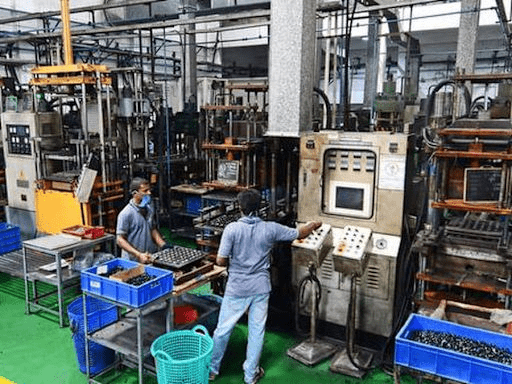
- The secondary sector, led by manufacturing, has been the core driver of Tamil Nadu’s economic strength, reinforcing its status as a major industrial powerhouse.
- Over the last four years, manufacturing GSDP increased by ₹1.46 lakh crore, almost double the rise recorded by Maharashtra (₹0.71 lakh crore).
- Tamil Nadu ranks first among all States in four-year average real manufacturing growth (2021–22 to 2024–25)at 9.38%.
- The State hosts 40,121 factories and employs 24.75 lakh factory workers, securing the top national position in factory employment.
- With over 39 lakh Udyam-registered MSMEs, Tamil Nadu ranks third nationally, reflecting a strong entrepreneurial ecosystem.
- The construction sector complemented industrial growth, expanding by 15.93% in 2023–24 and 11.56% in 2024–25.
- Tamil Nadu leads in exports of electronics, textiles, and leather, ranks second in engineering exports, and saw merchandise exports nearly double from $26.15 billion (2020–21) to $52.07 billion (2024–25).
- The State is a major automobile manufacturing hub, a pioneer in renewable energy, and the only State where every district is covered under one or more industrial corridors.
- Installed power capacity rose significantly from 35,139 MW to 42,772 MW between 2021–22 and 2024–25, supporting industrial expansion.
B. Services Sector, Human Capital, and Investment Climate
- The services sector, contributing 53.6% of the State’s GVA, recorded a strong real growth of 11.3% in 2024–25.
- Several sub-sectors achieved double-digit growth, including real estate (12.42%), public administration (14.2%), transport, storage and communication (11.29%), and other services (12.49%), indicating broad-based expansion.
- Tamil Nadu has the largest number of technical institutions in India (955), generating a highly skilled, disciplined, and technically proficient workforce.
- This strong human capital base continues to attract multinational corporations across manufacturing and services.
- The State is investing in research parks, incubation centres, and innovation clusters to build a knowledge-driven and technology-oriented economy, supported by forward-looking industrial and export policies.
- Tamil Nadu consistently ranks among the top States in FDI inflows, even as national FDI declined amid global uncertainties.
- FDI equity inflows rose from $2,169 million (2022–23) to $2,436 million (2023–24) and further to $3,681 millionin the subsequent year.
- At the Global Investors Meet 2024, the State signed 631 MoUs worth ₹6.64 trillion, reflecting strong investor confidence.
- Overseas investment outreach by the Chief Minister to the U.S., U.K., and Germany (2024–25) secured additional industrial commitments of ₹23,000 crore.
Welfare-Led Social Development
- The State has rolled out innovative welfare schemes targeting education, health, women’s empowerment, and social inclusion, such as Kalaignar Magalir Urimai Thittam, Magalir Vidiyal Payanam Thittam, Mudhalvarin Kaakkum Karangal Scheme, Naan Mudhalvan Thittam, and the Chief Minister’s Breakfast Scheme.
- Effective implementation has resulted in strong human development outcomes, including a low infant mortality rate of 12 per 1,000 live births (2023) and a low birth rate of 12 (2023).
- Tamil Nadu has one of the lowest multidimensional poverty levels in India at 1.43% (2022–23).
- The State ranks third nationally in life expectancy at 73.4 years, reflecting improvements in public health and nutrition.
- In education, Tamil Nadu ranks first in Gross Enrolment Ratio (GER) in higher education at 47%, well above the national average of 28.4%, and third in female GER at 47.3%.
- These outcomes highlight the success of a welfare-driven growth strategy that ensures inclusive and broad-based development.
Economic Rankings and Fiscal Stability
- Tamil Nadu ranks first in the Export Preparedness Index, demonstrating strong trade readiness and competitiveness.
- It stands second in the credit–deposit ratio at 120.5%, indicating robust financial intermediation.
- The State ranks third in total exports at $52,073.59 million and third in per capita NSDP income at ₹3.62 lakh (2024–25).
- On the fiscal front, Tamil Nadu has maintained macroeconomic stability, despite a reduction in Central transfers.
- The fiscal deficit is projected at 3% of GSDP in 2025–26 (BE), in line with fiscal discipline targets.
- The debt-to-GSDP ratio has improved, declining from 27% in 2021–22 to 26% in 2024–25 (BE), underscoring prudent fiscal management.
Conclusion
Tamil Nadu’s strong growth momentum, contained inflation, increasing FDI inflows, and robust export performance together create a solid base for achieving its $1 trillion economy target by 2031. Despite global tariff uncertainties, currency fluctuations, and declining Central fiscal support, the State remains well-positioned and firmly on course to attain this milestone.