


The Hindu Editorial Analysis
05 March 2026
Climate risks must prompt international legal reforms
(Source – The Hindu, International Edition, Page no.-10 )
Topic: GS Paper 2 – International Relations | GS Paper 3 – Environment
Introduction
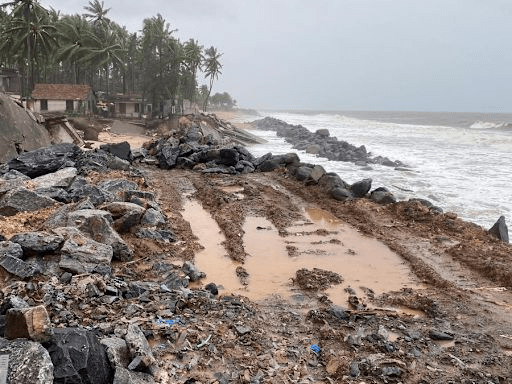
Climate change is no longer only an environmental issue; it is increasingly becoming a legal and geopolitical challenge. Rising sea levels, climate-induced displacement and pressures to phase out fossil fuels are likely to challenge foundational principles of international law such as sovereignty over natural resources, statehood and maritime jurisdiction. These emerging realities require urgent reform of existing international legal frameworks.
I. Challenge to Permanent Sovereignty over Natural Resources
The principle of Permanent Sovereignty over Natural Resources (PSNR) allows states to control and exploit natural resources within their territory.
However, climate change mitigation requires:
- Reduction of fossil fuel extraction.
- Transition to low-carbon economies.
This creates a tension between:
- Development rights of resource-rich developing countries.
- Global climate commitments such as the 1.5°C target under the Paris Agreement.
Scholars have proposed ideas such as a Fossil Fuel Non-Proliferation Treaty to restrict extraction and encourage a managed transition away from fossil fuels.
For such a transition to be equitable, developed countries must provide:
- Climate finance
- Technology transfer
- Support for energy transition in developing nations.
II. Climate Change and the Question of Statehood
International law traditionally requires four conditions for statehood under the Montevideo Convention (1933):
- Defined territory
- Permanent population
- Government
- Capacity to enter relations with other states
Sea-level rise threatens small island states by submerging their territories.
Key questions arise:
- Can a state continue to exist without territory?
- What happens to sovereignty if land disappears?
The International Court of Justice (ICJ) has indicated that the loss of territory does not automatically extinguish statehood, but the issue remains legally uncertain.
Small island states, particularly in the Pacific, have therefore called for international recognition of their continued statehood despite territorial loss.
III. Climate Change-Induced Migration
Climate change is expected to displace millions through:
- Sea-level rise
- Extreme weather events
- Desertification and drought
However, the 1951 Refugee Convention defines refugees narrowly as individuals fleeing persecution based on race, religion, nationality or political opinion.
Climate migrants do not fall within this definition.
As a result:
- There is no dedicated legal protection for climate refugees.
- Displaced persons may lose access to legal rights and social protections.
Experts suggest creating a separate international legal regime under the UNFCCC to recognise and protect climate-displaced persons.
IV. Unsettling of Maritime Zones
Sea-level rise also threatens existing maritime boundaries.
Under the United Nations Convention on the Law of the Sea (UNCLOS):
- Maritime zones are measured from coastal baselines.
If coastlines change due to sea-level rise:
- Territorial seas
- Exclusive Economic Zones (EEZs)
- Continental shelf claims
could shift significantly.
Some island states propose freezing current baselines permanently, ensuring their maritime rights remain intact despite rising seas.
This approach, however, requires reinterpretation or modification of UNCLOS rules.
V. Need for International Legal Reforms
To address climate risks, international law may need reforms in several areas:
- Recognition of climate refugees through new legal instruments.
- Protection of statehood for submerged island nations.
- Reform of maritime boundary rules under UNCLOS.
- Frameworks for managed fossil fuel phase-out.
- Strengthened climate finance and technology transfer mechanisms.
The UNFCCC and Conference of Parties (COP) processes could provide political support for such legal innovations.
Conclusion
Climate change is reshaping not only ecosystems but also the legal foundations of the international order. Issues such as disappearing territories, climate migration and shifting maritime boundaries challenge existing doctrines of international law. Addressing these challenges requires proactive reforms grounded in equity, multilateral cooperation and climate justice. Without such adaptation, the current legal framework may prove inadequate for the realities of a warming world.