


The Hindu Editorial
22 June 2026
End the Free Rein of Junk Food Advertising in India
(Source – The Hindu, Editorial Page no. – 8)
Topic: GS-2: Health Governance | Public Policy , GS-3: Human Development | Nutrition
Context
- India continues to witness aggressive advertising of Ultra-Processed Foods (UPFs) and High Fat, Sugar and Salt (HFSS) foods.
- Despite growing evidence linking these products to obesity, diabetes and other NCDs, regulation of food advertising remains weak.
- The editorial argues that protecting children from misleading food marketing is now a public health necessity.
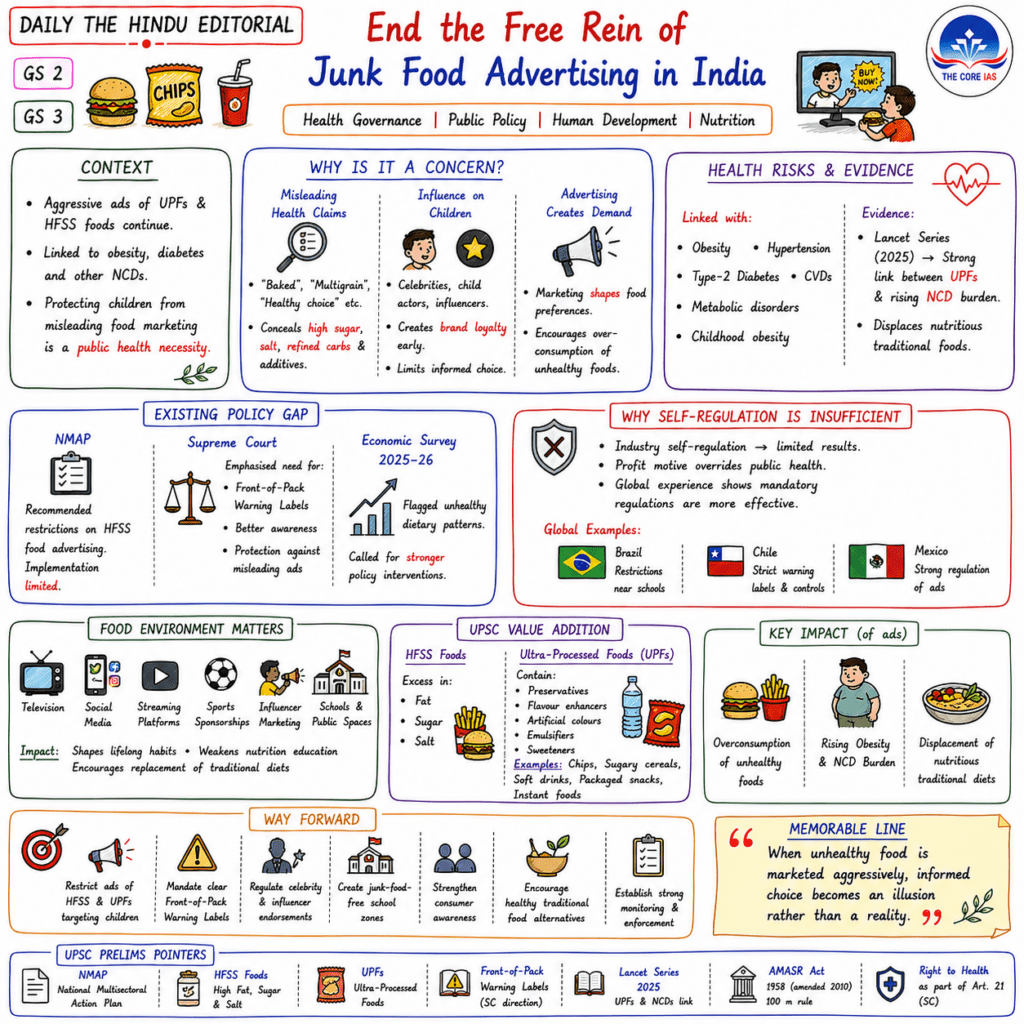
Why Is Junk Food Advertising a Concern?
Misleading Health Claims
- Advertisements highlight selective positives such as:
- “Baked”
- “Multigrain”
- “12-grain”
- “Healthy choice”
- Often conceal:
- High sugar content
- Excess salt
- Refined carbohydrates
- Artificial additives and flavour enhancers
Influence on Children
- Use of:
- Celebrities
- Child actors
- Influencers
- Emotional messaging
- Creates brand loyalty at an early age.
- Limits informed consumer choice.
Advertising Creates Demand
- Marketing does not merely reflect consumption.
- It actively shapes food preferences and eating habits.
- Frequent exposure encourages overconsumption of unhealthy foods.
Health Risks of UPFs and HFSS Foods
Linked with:
- Obesity
- Type-2 Diabetes
- Hypertension
- Cardiovascular diseases
- Metabolic disorders
- Childhood obesity
Evidence
- The Lancet Series (2025) highlighted strong links between UPF consumption and rising NCD burden.
- Increasing UPF intake is associated with displacement of nutritious traditional foods.
Existing Policy Gap
National Multisectoral Action Plan (NMAP)
- Recommended restrictions on HFSS food advertising.
- Implementation remains limited.
Supreme Court Observations
- Emphasised need for:
- Front-of-Pack Warning Labels
- Better consumer awareness
- Protection against misleading advertisements
Economic Survey 2025-26
- Flagged concerns regarding unhealthy dietary patterns.
- Called for stronger policy interventions.
Why Self-Regulation Is Insufficient?
- Industry self-regulation has produced limited results.
- Profit incentives often outweigh public health concerns.
- International experience shows mandatory regulations are more effective.
Global Examples
- Brazil: Restrictions around school environments.
- Chile: Strict warning labels and marketing controls.
- Mexico: Strong regulation of unhealthy food advertising.
Food Environment Matters
Children encounter junk food promotion through:
- Television
- Social media
- Streaming platforms
- Sports sponsorships
- Influencer marketing
- Schools and public spaces
Impact
- Shapes lifelong consumption behaviour.
- Weakens nutrition education efforts.
- Encourages replacement of traditional diets with processed foods.
UPSC Value Addition
HFSS Foods
Foods containing excessive:
- Fat
- Sugar
- Salt
Ultra-Processed Foods (UPFs)
Industrially manufactured foods containing:
- Preservatives
- Flavour enhancers
- Artificial colours
- Emulsifiers
- Sweeteners
Examples:
- Chips
- Sugary cereals
- Soft drinks
- Packaged snacks
- Instant foods
Way Forward
- Restrict advertising of HFSS and UPFs targeting children.
- Mandate clear Front-of-Pack Warning Labels.
- Regulate celebrity and influencer endorsements.
- Create junk-food-free school zones.
- Strengthen consumer awareness campaigns.
- Encourage healthier traditional food alternatives.
- Establish stronger monitoring and enforcement mechanisms.
Conclusion
- Rising obesity and lifestyle diseases cannot be tackled through awareness campaigns alone. A healthy food environment requires stronger regulation of misleading advertisements and greater protection of children from aggressive marketing practices.