


The Hindu Editorial Analysis
24 January 2026
India and the EU — a fit partnership in a divided world
(Source – The Hindu, International Edition, Page no.-8 )
Topic: GS Paper – GS-2 : International Relations, India–EU Relations, Trade, Strategic Autonomy
Context
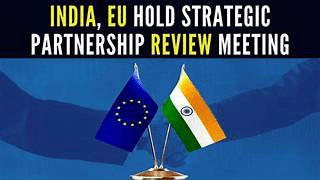
In an increasingly fragmented global order, clarity in partnerships has become rare but essential. The deepening relationship between India and the European Union (EU) is entering such a decisive moment. The upcoming visit of the President of the European Commission, Ursula von der Leyen, and the President of the European Council, António Luís Santos da Costa, to New Delhi — as chief guests at India’s 77th Republic Day and co-chairs of the 16th India–EU Summit — signals more than diplomatic symbolism. It reflects a shared urgency to translate intent into action, especially as both sides navigate geopolitical uncertainty, trade tensions, and the quest for strategic autonomy.
Core Issue
The central issue is whether India and the EU can convert long-standing but under-realised potential into a substantive, outcome-oriented partnership.
In a world marked by U.S. unpredictability and China’s assertiveness, the India–EU relationship offers a rare convergence of values, interests, and strategic necessity.
A Relationship Long on Promise, Short on Delivery
For years, India–EU ties have been characterised by ambition without momentum.
- Progress has been episodic rather than structural.
- Engagement has often been overshadowed by:
- Russia–Ukraine tensions,
- China-centric narratives,
- Each side’s prioritisation of relations with the United States.
Yet, Europe now recognises that alliances alone do not guarantee security, and India has learnt that strategic patience must give way to strategic autonomy. This convergence creates a window for relationship-defining outcomes.
What the Free Trade Agreement Can Deliver
The long-pending India–EU Free Trade Agreement (FTA), under negotiation since 2007, is at a critical juncture.
If viewed as geopolitical insurance rather than a narrow trade deal, the FTA could:
- Unlock opportunities for India in textiles and apparel through tariff reductions,
- Boost pharmaceutical and chemical exports where India holds a competitive edge,
- Expand EU access to India’s growing market in automobiles and machinery,
- Enhance cooperation in digital and services trade through regulatory harmonisation.
For India, the FTA also raises concerns of climate equity, particularly the EU’s Carbon Border Adjustment Mechanism (CBAM), which imposes a significant carbon cost on exports such as steel, aluminium, cement and fertilisers. Without accommodation, CBAM risks diluting FTA gains and functioning as a non-tariff barrier. A balanced resolution is therefore essential.
Defence and Strategic Cooperation
Beyond trade, the most consequential yet difficult conversation lies in defence and security.
The EU has proposed a Security and Defence Partnership with India, comparable to its arrangements with Japan and South Korea. For Europe, this offers:
- Access to India’s defence market,
- Opportunities for co-production and industrial collaboration.
For India, it complements the Make in India initiative by:
- Supporting indigenous defence manufacturing,
- Providing access to advanced European technology,
- Enabling greater coordination and joint exercises, particularly in the Indian Ocean region.
Unlike trade negotiations, defence cooperation may not attract headlines, but it is central to long-term strategic trust.
Strategic Autonomy as a Shared Principle
At the heart of India–EU alignment lies a shared belief in strategic autonomy.
- Both have paid the price of over-dependence — the EU on Russian gas, India on constrained global supply chains.
- Both now seek flexibility, diversification, and resilience rather than bloc politics.
Crucially, this partnership rests on mutual respect for sovereign choices, rejecting veto power by external actors — whether Beijing, Moscow, or Washington.
A Template for a Fragmented World
The editorial argues that the India–EU partnership could serve as a model for recalibrated global engagement.
In a time when:
- U.S. policy swings disrupt predictability,
- China’s economic and strategic posture remains assertive,
India and the EU can demonstrate how partnerships can be:
- Principled yet pragmatic,
- Respectful of domestic sensitivities,
- Anchored in shared but non-coercive interests.
This model emphasises cooperation without dependence and alignment without subordination.
The Road Ahead
India and the EU possess:
- Credibility,
- Economic weight,
- Institutional capacity,
to co-create a new chapter in multilateralism. However, success will depend on:
- Moving beyond bureaucratic inertia,
- Avoiding narrative distractions,
- Focusing on deliverables in trade, defence, climate cooperation and technology.
If seized decisively, this moment could help shape a multipolar order that is resilient, equitable and sovereign.
Conclusion
In a divided world searching for reliable partners, India and the European Union are well-matched. Their partnership is grounded not in convenience but in necessity — economic, strategic and normative.
If both sides choose action over hesitation, the India–EU relationship can move from unrealised potential to strategic ballast, offering stability and balance in an increasingly uncertain global landscape.