


The Hindu Editorial Analysis
19 January 2026
India–Germany ties can only soar higher
(Source – The Hindu, International Edition, Page no.-8 )
Topic: GS Paper – GS-2 : International Relations, Bilateral Relations, Trade & Migration
Context
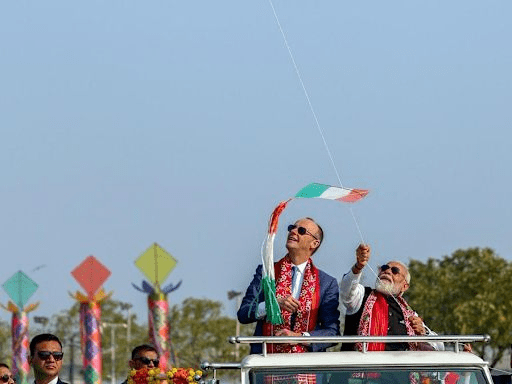
The recent visit of German Chancellor Friedrich Merz to India, marked symbolically by his kite-flying with Prime Minister Narendra Modi in Ahmedabad, underscored the deepening strategic partnership between the two countries. Beyond symbolism, the visit reflected shared concerns over global economic uncertainty, disruptions to the rules-based international order, and the need for resilient, predictable growth. The editorial argues that India–Germany relations are entering a phase of greater economic, strategic, and people-centric convergence.
Core Issue
The central issue is how India and Germany can leverage their complementary strengths to deepen cooperation in trade, migration, defence, and global governance amid an increasingly volatile international environment.
The partnership is no longer transactional but strategic, rooted in shared economic interests and long-term resilience.
Shared Economic Stakes
India and Germany are economic heavyweights — the third- and fourth-largest economies globally, respectively.
- A stronger Indian economy creates:
- A larger market for German goods,
- Greater opportunities for German businesses and consumers.
- A stronger German footprint in India:
- Enhances competitiveness of Indian companies,
- Integrates India more deeply into global value chains.
The editorial stresses that the global economy is not a zero-sum game — when India grows, Germany benefits, and vice versa.
Trade and Strategic Resilience
A key message from Chancellor Merz’s visit was the urgency of:
- A European Union–India Free Trade Agreement,
- Reducing vulnerability to unpredictable trade wars and supply-chain disruptions.
Such an agreement would:
- Propel both economies to the next level,
- Enhance resilience against external shocks,
- Strengthen the economic foundation of the bilateral partnership.
Merz’s visit — his first outside the Western alliance — signalled Germany’s intent to place India at the centre of its long-term economic strategy.
Migration as a Strategic Partnership
Migration emerged as a core pillar of India–Germany ties.
Germany:
- Continues to welcome skilled, adaptable, and motivated Indian professionals,
- Sees Indian migrants as contributors to its economic and demographic needs.
India–Germany migration cooperation is built on:
- Safe, legal, and predictable pathways,
- Mutual benefit rather than short-term labour extraction.
The anecdote of Chancellor Merz’s interaction with young Indians aspiring to move to Germany highlights the human dimension of the partnership — marked by ambition, adaptability, and long-term planning.
People-to-People and Knowledge Links
India’s young professionals are characterised by:
- Quick adaptability,
- Strong educational foundations,
- Global outlook and perseverance.
As traditional professional pathways close in parts of the world, Germany’s openness to Indian talent strengthens:
- Educational exchanges,
- Skill mobility,
- Long-term societal bonds between the two countries.
Platinum Jubilee of Diplomatic Relations
In 2026, India and Germany will mark 75 years of diplomatic ties.
This milestone reflects:
- A partnership that has matured beyond episodic cooperation,
- Increasing strategic alignment in response to global instability,
- A clear shared direction for future collaboration.
The editorial views the anniversary as an opportunity to institutionalise gains and chart a long-term roadmap.
The Road Ahead
Key building blocks for a durable partnership include:
- Finalisation of the EU–India Free Trade Agreement,
- Deeper defence and security cooperation,
- Stronger migration and education linkages,
- Expanding people-to-people ties.
The forthcoming Intergovernmental Consultations between India and Germany are expected to translate intent into concrete outcomes.
Conclusion
India–Germany relations are poised to rise higher, driven by economic complementarity, shared strategic concerns, and robust human connections. What began symbolically with kites in the skies of Ahmedabad reflects a partnership ready to navigate global turbulence together.
As India and Germany celebrate decades of diplomatic engagement, their collaboration stands as a model of how two democracies can combine economic ambition with mutual trust to build a resilient, future-oriented partnership.