


The Hindu Editorial Analysis
9 December 2025
The Real Story of the India–Russia Summit
(Source – The Hindu, International Edition – Page No. – 8)
Topic : GS Paper II – International Relations | India–Russia Relations | Global Geopolitics
Context
The 23rd India–Russia Annual Summit, held in New Delhi, reaffirmed the resilience of the India–Russia partnership amid shifting global alliances and geopolitical turbulence.
While the Ukraine war has redefined global polarities and strained Russia’s ties with the West, India has pursued a strategic re-engineering of its engagement with Moscow—balancing old ties with new realities.
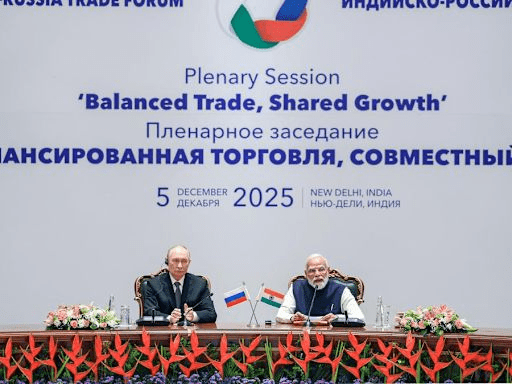
The author argues that the summit was not merely symbolic but a strategic recalibration of bilateral ties aimed at future-proofing India’s energy security, trade diversification, and technological cooperation.
1. Significance and Timing
- The visit of President Vladimir Putin (his first since the Ukraine war) and the high-level delegation underscored mutual confidence in the partnership.
- For India, the summit removed ambiguity around its Russia policy, signalling that strategic autonomy remains central to its foreign policy doctrine.
- The timing—amid Ukraine’s military reverses and renewed U.S.-Russia hostility—suggests India’s calculated endorsement of dialogue over isolation.
- The author notes that India’s open reception of Russia complements its U.S. ties, showing that India can maintain parallel strategic tracks with rival powers.
2. Key Pillars of India–Russia Ties
(a) Trade and Economic Diversification
- Adoption of the “Programme 2030” for Strategic Economic Cooperation aims to reach $100 billion trade by 2030.
- Focus areas:
- Removal of non-tariff barriers
- Settlement of trade in national currencies (rupee–ruble mechanism)
- Investment in non-energy sectors like railways, fertilizers, and pharma
- Russia’s vast mineral and resource base offers India critical supply-chain security.
(b) Energy Security
- India is now the second-largest importer of Russian crude oil, with imports rising 10× since 2022.
- Russia’s reliable energy supply at discounted rates enhances India’s energy resilience and inflation control.
- The editorial warns that failure to secure Russian resources could leave India vulnerable to Western supply volatility and Chinese monopolization.
(c) Connectivity and Maritime Cooperation
- India and Russia are advancing:
- Chennai–Vladivostok Maritime Corridor,
- Northern Sea Route, and
- Shipbuilding cooperation in the Arctic.
- These initiatives aim to strengthen India’s Indo-Pacific presence while preserving its continental Eurasian linkages.
(d) Labour Mobility and People-to-People Ties
- A major new agreement allows Indian skilled workers to Russia, addressing Moscow’s demographic crisis and labour shortage.
- Russia’s easing of visa norms signals a more long-term people-centric partnership.
(e) Defence, Science, and Technology
- India–Russia collaboration in nuclear energy, space, and defence remains a cornerstone of the relationship.
- BrahMos missile and S-400 systems symbolize deep strategic trust.
- With localisation and technology transfer, India is moving toward self-reliance while maintaining Russian interoperability.
3. Strategic Re-Engineering and Global Balancing
- The summit marks a re-engineering of India–Russia ties, with both sides adapting to multipolar realities:
- Russia re-engages with Asia as Western isolation deepens.
- India leverages this to expand its Eurasian reach while preserving ties with the U.S. and Europe.
- The author calls this “parallel engagement diplomacy”—India’s art of maintaining friendships across rival blocs without compromising autonomy.
4. Broader Implications for India’s Foreign Policy
- The summit strengthens India’s continental strategy, balancing its maritime Indo-Pacific focus.
- It reinforces India’s role as a bridge between East and West, particularly relevant as both Russia–China and U.S.–Europe alliances harden.
- For Russia, India represents a stable, non-Western partner that legitimises Moscow’s global outreach.
Conclusion
“India has re-engineered the relationship with Moscow without rupturing its equations with the West.”
The editorial concludes that India has successfully navigated a delicate geopolitical balancing act, preserving its long-standing strategic partnership with Russia while pursuing closer engagement with the United States and Europe.
The India–Russia Summit 2025 signals a forward-looking partnership—anchored in energy, technology, and trust—that keeps India central to the evolving multipolar order.