


The Hindu Editorial Analysis
27 February 2026
The shift of critical minerals to India’s strategic centre
(Source – The Hindu, International Edition, Page no.-10 )
Topic: GS2 – Indian Constitution & Polity
Introduction
Critical minerals — such as lithium, rare earth elements, cobalt, nickel, tantalum and graphite — have moved from the margins of policy discourse to the core of India’s industrial, energy, and geopolitical strategy. The Union Budget 2026 signals a decisive shift: the debate is no longer whether India needs a critical minerals policy, but whether it can execute at scale, speed and technological depth.
In a world where supply chains are increasingly weaponised, mineral security is national security.
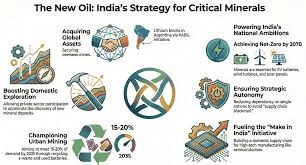
The Strategic Shift
Until recently:
- Several critical minerals were classified as atomic minerals, restricting private exploration.
- Policy attention remained limited.
Today:
- India has identified 30 critical minerals.
- Royalty rates have been rationalised.
- Exploration eased for junior miners.
- National Critical Mineral Mission (NCMM) launched (₹16,300 crore outlay).
India now joins a small group of nations with a structured mineral security framework.
Why Critical Minerals Matter
Critical minerals underpin:
- Electric vehicles (EV batteries).
- Renewable energy (solar, wind).
- Semiconductors.
- Defence technologies.
- Rare earth magnets.
China controls nearly 90% of global processing capacity for several critical minerals, exposing global vulnerabilities.
Thus, supply diversification and domestic capability building are strategic imperatives.
India’s Existing Capabilities
India already produces:
- High-purity copper
- Graphite
- Rare earth oxides
- Titanium
- Tin
However:
- Production is largely geared toward conventional uses.
- Limited capacity for advanced refining and value addition.
- Clean tech and defence applications require higher purity and scale.
The challenge lies in moving up the value chain.
Priority Areas Going Forward
Demand Creation
The biggest constraint is not only supply but assured domestic demand.
- Budget removes import duties on capital goods used in mineral processing.
- However, investors need stable downstream demand.
Boosting deployment of:
- EVs
- Solar modules
- Wind turbines
- Battery manufacturing
creates third-order effects strengthening mining and refining ecosystems.
Industrial policy must complement mineral policy.
AI-First Exploration Strategy
Exploration remains slow and capital-intensive.
NCMM targets:
- 1,200 exploration projects by FY2031.
Budget reforms:
- Exploration expenditure eligible for tax deductions (for 9 minerals).
India should:
- Mandate AI-driven geospatial exploration.
- Integrate:
- IndiaAI Mission
- National Geospatial Policy
- Mission Anveshan
Data-driven prospectivity analysis can reduce exploration risks and timelines.
Processing & Refining Capacity
Mining alone is insufficient.
India must:
- Invest in deep refining.
- Develop chemical processing capabilities.
- Leverage expertise from:
- Pharmaceuticals
- Chemicals
- Textiles
Value addition determines strategic leverage.
Rare Earth Corridors
The government’s decision to:
- Establish rare earth corridors in coastal states.
- Reduce import duties on monazite sands.
Is timely in light of rare earth magnet supply disruptions.
States must leverage infrastructure and skilled manpower to serve global markets.
Geopolitical Dimensions
Critical minerals are increasingly weaponised.
- Rare earth magnet restrictions.
- Battery supply chain disruptions.
- Technology transfer hesitations.
India must pursue:
- Partnerships with Australia, Japan, EU, UK, USA.
- Joint ventures in processing and advanced manufacturing.
- Institutional collaborations (e.g., UK-India Critical Minerals Supply Chain Observatory).
Trade agreements (such as India–EU FTA) should embed mineral cooperation frameworks.
Institutional Challenges
- Long gestation periods for mining projects.
- Environmental clearances.
- Technology gaps in processing.
- Limited risk capital.
- Global competition for resources.
Execution, not ambition, will determine outcomes.
Broader Economic Significance
Critical minerals are foundational to:
- Clean energy transition.
- Manufacturing self-reliance.
- Semiconductor ambitions.
- Defence modernisation.
- Export competitiveness.
They align with:
- Atmanirbhar Bharat.
- Viksit Bharat vision.
- Net-zero 2070 goal.
Conclusion
India’s elevation of critical minerals to the strategic centre reflects an understanding that industrial sovereignty in the 21st century rests on control over mineral supply chains. Budget 2026 and the National Critical Mineral Mission provide a strong foundation, but sustained momentum requires:
- Demand creation.
- AI-driven exploration.
- Advanced refining capacity.
- International partnerships.
- Inter-ministerial coordination.
In a turbulent global order, mineral security will define technological leadership. If executed with speed and coordination, India can transition from a resource-dependent importer to a strategic player in global critical mineral supply chains.